

Every painting style begins as a set of choices: how to treat line, color, light, and subject. Follow those choices across four centuries and you can read the whole argument of Western art, moving from patient realism toward pure abstraction. This guide walks through the major types of painting styles, what separates one from the next, and why each still shapes the way we look at pictures.
Table of Content
- What Counts as a Painting Style
- Realism and the Observed World
- Impressionism and the Play of Light
- Bold Color and Expression
- Abstraction, Pop, and the Modern Turn
What Counts as a Painting Style?
A painting style is a recognizable way of handling the basic tools of the medium: brushwork, palette, composition, and the artist's attitude toward the subject. Two painters can stand before the same harbor and produce completely different pictures; the distance between them is style. Some styles chase a faithful record of what the eye sees, while others bend color and form to carry mood or ideas. Most of the movements below overlap in time, borrow freely from one another, and argue with whatever came before them.
It helps to picture these styles as a rough sequence rather than a set of sealed boxes. Each generation inherited a set of rules, kept some, and broke the rest.
A Rough Timeline of Major Styles
Source: The Met, Heilbrunn Timeline of Art History
Realism and the Observed World
Realism sets out to present the world as it is, without polishing it into something grander. Figures look like ordinary people, light behaves the way it does at a specific hour, and the subject often comes from daily life rather than myth or scripture. The style rewards close looking and steady craftsmanship, and it values honesty over spectacle.
In the United States, that instinct found its most ambitious form in landscape. The painters who treated wild American scenery as a subject worthy of serious art created America's first and most influential school of landscape painting, rendering mountains and rivers with almost scientific care. Those detailed vistas tie directly into the history of Americana art, where the land itself carries a sense of national identity.
Impressionism and the Play of Light
Impressionism traded fine finish for the fleeting effects of light. Working outdoors, its painters used short, broken strokes of pure color placed side by side, letting the eye mix them at a distance. Shadows turned blue and violet instead of dull brown, and a canvas could capture a single passing moment rather than a permanent, idealized scene. What looked unfinished to critics in the 1870s reads now as fresh and alive.
The lesson of the movement was simple but far reaching: color and perception could take priority over line and outline. Nearly every later style built on that permission.
Bold Color and Expression
If Impressionism loosened color from careful description, the styles that followed set it loose entirely. The Fauves, led by Henri Matisse and André Derain, used bold, arbitrary color and crudely simplified forms, treating a green stripe down a face or a red sky as fair game. Expressionism pushed further, using distortion and intense hue to convey inner feeling rather than outward fact.
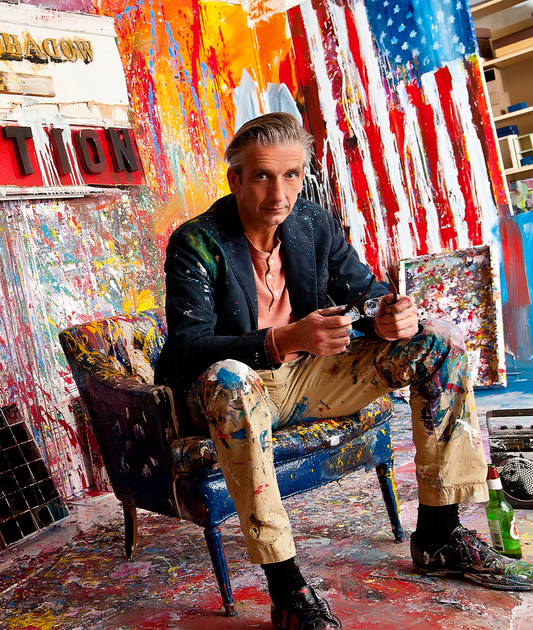
This appetite for saturated color runs straight into contemporary work. The paintings of Steve Penley Art reinterpret American icons in thick, high-key color that owes a clear debt to these movements, proving the Fauve gamble still pays off on a modern canvas.
Abstraction, Pop, and the Modern Turn
Abstraction removed the recognizable subject altogether, letting shape, color, and gesture stand on their own. Pop Art then swung back toward the everyday, borrowing soup cans, comic panels, and celebrity portraits from mass culture and presenting them as fine art. The famous Pop Art artists turned commercial imagery into sharp commentary on consumer life.
Taken together, these styles form a single long conversation about what a painting can be. Seeing where American subjects fit into that story also means understanding what Americana really means as a visual tradition.
Related reading: browse the Americana collection, then read more on Americana art history and the famous Pop Art artists who reshaped the modern canvas.