
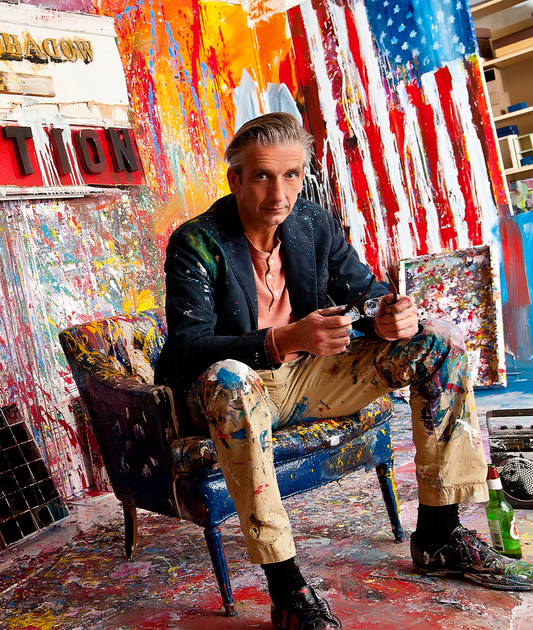

!When Tiger Woods burst onto the professional scene in 1996 with a "Hello World," he didn't just change golf scores; he changed the visual language of sports. Before Tiger, golf art was often pastoral—quiet landscapes of rolling greens and distant clubhouses. Tiger Woods artwork and canvas paintings changed the golf art game.
Tiger brought a visceral intensity to the game that demanded a new kind of artistic expression.
From bold neo-pop interpretations to classic impressionism, artists have clamored to capture his likeness for decades. Below, we explore the background of Tiger Woods in canvas wall art and count down the 5 best paintings of the golf legend that is Tiger, starting with a modern masterpiece that defines his intensity.
The 5 Best Tiger Woods Paintings
1. Steve Penley: "Tiger Woods"
The Modern Icon: If you are looking for a piece that strips away the noise and focuses entirely on the sheer power of the athlete, Steve Penley’s interpretation is the gold standard. Penley is renowned for his bold, aggressive style—often using broad brushstrokes and dripping paint to create images that feel alive and kinetic.
 In this specific work, Penley avoids the typical "mid-swing" action shot that can sometimes look like a stiff photograph. Instead, he focuses on the portrait—the eyes and the intensity. Executed in his signature high-contrast style, often utilizing stark blacks and whites with splashes of color, this painting captures the psychological weight of Tiger Woods. It is the face of a man who stares down history.
This piece works exceptionally well in modern offices or studies because it feels contemporary and sophisticated, avoiding the "sports bar" look of traditional memorabilia. You can view this stunning piece here: Steve Penley - Tiger Woods
Also check out Tiger Woods giclees, which could serve as a great golf gift!
2. LeRoy Neiman: "Portrait of the Tiger" (1998)
The Colorful Classic: LeRoy Neiman was the grandfather of modern sports art. Known for his kaleidoscope of colors and impressionist style, he painted everyone from Muhammad Ali to Frank Sinatra. His 1998 serigraph, "Portrait of the Tiger," is arguably the most famous artistic rendering of the golfer.
Neiman famously captured Tiger’s "cat-like" eyes. In this piece, the background is a swirling abstraction of energy, while Tiger’s face remains a calm, focused center. Neiman often sketched live at major tournaments, and this energy translates to the canvas, making the viewer feel the electricity of a Sunday at the Masters.
3. Stephen Holland: "Sunday Red"
The Gritty Hero: While Neiman is about color, Stephen Holland is about grit. Holland is considered one of the greatest living sports artists, known for a style that blends realism with an abstract, textured background. His painting "Sunday Red" is a fan favorite because it captures the moment every golfer fears and every fan loves: Tiger stalking a putt in his final-round crimson shirt.
Holland uses a unique technique where he paints on board or canvas with heavy texture, often using gold or silver pens for highlights. His Tiger looks like a warrior—weathered, tough, and unbreakable. This is the art of the comeback.
4. Rick Rush: "The Masters of Augusta" (1998)
The Historic Narrative: This painting is famous not just for its beauty, but for the legal battle it sparked. Rick Rush, known as "America’s Sports Artist," painted this piece to commemorate Tiger’s historic 1997 Masters win. It features a montage of Tiger’s swing superimposed over the faces of past legends like Jack Nicklaus and Arnold Palmer, symbolizing the passing of the torch.
The painting became the subject of a landmark First Amendment case (ETW Corp. v. Jireh Publishing) regarding an artist's right to paint public figures. The court ruled in favor of the artist, cementing this painting as a symbol of artistic freedom. Owning a print of this is owning a piece of legal and sports history.
5. Malcolm Farley: "Victory at the British Open"
The Live Experience Malcolm Farley is known for setting up his easel right on the sidelines of major sporting events and painting the action as it happens. His style is loose, fluid, and incredibly vibrant, often using a palette knife to apply thick layers of paint.
His depictions of Tiger, particularly from the early 2000s "Tiger Slam" era, are filled with motion. Unlike the stoic portraits of Penley or Holland, Farley’s work is about the swing itself—the blur of the club and the body in motion. It captures the athleticism of Woods, reminding us that before he was a legend, he was a phenomenal athlete.
Background: A History of Greatness on Canvas
Why is Tiger Woods such a popular subject for fine art? It comes down to the "Hero's Journey."
In the late 90s, Tiger was painted as a prodigy—a young, smiling phenomenon. Artists focused on his youth and the breaking of racial barriers in a traditionally white sport. As his career progressed, the art shifted. The "Sunday Red" became a visual shorthand for danger. Artists started painting him darker, more focused, and more muscular.
After his injuries and his 2019 Masters comeback, the art evolved again. Contemporary pieces, like the one by Steve Penley, now depict him as a statesman of the game—a figure of resilience rather than just raw talent.
Collecting Tiger Woods canvas art is about tracking this evolution. It is about choosing which version of the legend speaks to you: the young phenom, the dominant conqueror, or the resilient icon. Whether you choose the bold, modern strokes of a Penley or the historic narrative of a Rush, you are hanging a story of American greatness on your wall.v