
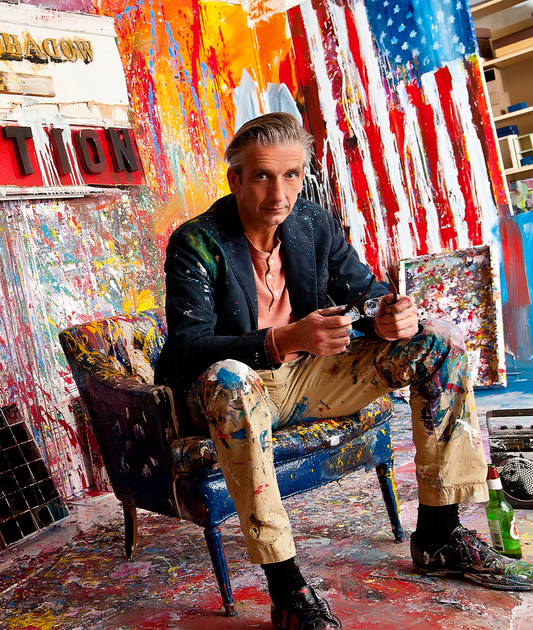

Few artists are as tightly stitched into the fabric of American identity as Norman Rockwell (1894–1978). For more than six decades, he painted the barber shops, town meetings, soda fountains, and family dinners that became shorthand for a whole way of life. His images didn’t just illustrate Americana art — they helped invent it. Today, many more artists have emerged including Americana artist Steve Penley.
As for Rockwell? His canvases hang in major museums, sell for tens of millions at auction, and continue to shape how the world pictures small-town America.
This guide walks through Rockwell’s life, his place in the Americana tradition, his most iconic works, and why collectors and curators keep returning to his warm, meticulous vision of everyday life.
What Is Americana Art?
Americana refers to a broad category of objects, images, and symbols considered inherently American — think diners, main streets, baseball, barn raisings, Coca-Cola bottles, road trips, and the idea of the American Dream itself. In the visual arts, Americana describes work that celebrates (and sometimes gently critiques) the everyday rituals and folk character of life in the United States.
Americana painting overlaps with several formal movements:
- American Regionalism — rural Midwestern scenes by Grant Wood, Thomas Hart Benton, and John Steuart Curry.
- American Scene Painting — urban and small-town subjects rendered with realist honesty.
- Genre illustration — narrative pictures made for magazines, calendars, and advertising, which is where Rockwell became a household name.
- Folk and primitive painting — self-taught traditions like those of Grandma Moses, who was, notably, Rockwell’s neighbor in Arlington, Vermont.
To see how deep this tradition runs, institutions like the Crystal Bridges Museum of American Art in Bentonville, Arkansas, now devote entire wings to five centuries of American masterworks, placing Rockwell in direct conversation with Gilbert Stuart, Asher B. Durand, and Georgia O’Keeffe.
Who Was Norman Rockwell? A Short Biography
Norman Percevel Rockwell was born in New York City on February 3, 1894. He knew by age 14 that he wanted to be an artist, left high school early, and trained at the Chase School, the National Academy of Design, and the Art Students League. By 22, he had published his first cover for The Saturday Evening Post — the beginning of a 47-year relationship that would produce more than 320 covers.
According to the Smithsonian American Art Museum, Rockwell called the Post "the greatest show window in America," and his covers delivered his view of that window to millions of households every week. His later work for Look magazine turned toward civil rights, poverty, and space exploration, proving he could do far more than nostalgia.
Key Milestones
- 1916 — First Saturday Evening Post cover, Boy with Baby Carriage.
- 1939 — Moves to Arlington, Vermont; begins painting full-canvas scenes of rural New England life.
- 1943 — Publishes the Four Freedoms series, his most influential wartime work.
- 1953 — Relocates to Stockbridge, Massachusetts, where he will spend the rest of his life.
- 1963 — Leaves the Post for Look, embracing socially conscious subjects.
- 1964 — Paints The Problem We All Live With, depicting Ruby Bridges’ school integration.
- 1977 — Receives the Presidential Medal of Freedom from President Gerald Ford.
- 1978 — Dies at his Stockbridge home on November 8.
Rockwell and the Birth of Visual Americana
Rockwell didn’t simply record American life — he distilled it. He worked like a film director, casting neighbors as models, staging each scene with props and costumes, photographing every angle, and then translating the shot into a carefully composed oil painting. The result was an idealized but recognizable America, full of humor, small embarrassments, and quiet dignity.
His own words, widely quoted in museum literature, explain his approach well: as the world proved imperfect, he decided that if it could not be ideal, he would at least paint its ideal aspects. That choice drew sharp criticism from mid-century modernists who dismissed his work as sentimental — yet it also built one of the most recognizable bodies of American art ever created.
The Four Freedoms: Americana Meets Global History
In 1943, Rockwell painted four oil paintings inspired by President Franklin D. Roosevelt’s 1941 State of the Union address: Freedom of Speech, Freedom of Worship, Freedom from Want, and Freedom from Fear. Rather than illustrate abstract political ideals, he grounded them in ordinary scenes — a man speaking at a town meeting, parents tucking children into bed, a Thanksgiving dinner.
The series ran in four consecutive issues of The Saturday Evening Post, then toured 16 U.S. cities alongside a war bond drive. According to the Museum of Fine Arts, Houston, the tour reached more than a million visitors and raised roughly $132 million in bonds and stamps for the war effort — a staggering figure that made Rockwell’s brushwork a genuine force in American history.
Most Famous Works at a Glance
The table below summarizes several of Rockwell’s best-known paintings, all of which are closely tied to the Americana tradition:
| Painting | Year | Original Use | Why It Matters |
|---|---|---|---|
| Boy with Baby Carriage | 1916 | First Saturday Evening Post cover | Launched his 47-year Post career. |
| Freedom from Want | 1943 | Four Freedoms series | Defined the American Thanksgiving image. |
| Freedom of Speech | 1943 | Four Freedoms series | Small-town democracy as civic icon. |
| Saying Grace | 1951 | Post cover | Sold for $46 million in 2013 — a Rockwell record. |
| Girl at Mirror | 1954 | Post cover | Captured the tender ache of growing up. |
| The Problem We All Live With | 1964 | Look magazine | Landmark civil rights image; hung in the Obama White House. |
A Career in Numbers
Rockwell’s output is almost hard to believe. The chart below visualizes a few of the most striking totals from his life and legacy — a reminder of just how prolific America’s most famous Americana painter really was.
The Norman Rockwell Museum and His Enduring Legacy
In 1973, Rockwell established an art trust that eventually became the Norman Rockwell Museum in Stockbridge, Massachusetts. The museum holds roughly 998 original paintings and drawings, plus an archive of more than 100,000 letters, photographs, and business documents. His Stockbridge studio — the only one of 21 working studios preserved from his lifetime — sits on the museum grounds, with easels, brushes, reference photos, and pigments arranged much as he left them.
In 2022, the studio joined the National Trust for Historic Preservation’s Historic Artists’ Homes and Studios program, cementing Rockwell’s place among the most important American artist-homes open to the public.
Why Collectors Still Chase Rockwell
- Blue-chip auction results. Saying Grace sold for roughly $46 million at Sotheby’s in 2013, and Breaking Home Ties fetched $15.4 million in 2006.
- Hollywood influence. Directors George Lucas and Steven Spielberg collect his work; their paintings anchored a major touring Smithsonian exhibition.
- Cross-generational recognition. His images appear on posters, puzzles, stamps, and greeting cards, keeping them in constant cultural circulation.
- Scholarly rehabilitation. Once dismissed by critics, Rockwell is now studied at institutions like the Rockwell Center for American Visual Studies, a research arm of the Norman Rockwell Museum.
How to See Rockwell’s Americana in Person
If you want to experience Rockwell’s Americana art firsthand, several institutions offer excellent entry points:
- Norman Rockwell Museum — Stockbridge, MA: the definitive collection, including the Four Freedoms gallery.
- Smithsonian American Art Museum — Washington, D.C.: holds the Lucas-Spielberg collection alongside other American masters.
- Museum of Fine Arts, Houston — has hosted major Rockwell exhibitions including American Freedom.
- Crystal Bridges Museum of American Art — Bentonville, AR: places Rockwell within five centuries of American painting.
- National Museum of American Illustration — Newport, RI: situates him among peers like N.C. Wyeth, J.C. Leyendecker, and Howard Pyle (see the NMAI’s Rockwell profile).
For a deeper dive into the broader tradition he belongs to, the American Art movement overview at The Art Story traces the long arc from colonial portraiture through the Hudson River School and into modern American painting — the lineage Rockwell both inherited and redefined.
The TLDR: Why Rockwell Still Matters
Norman Rockwell has been called sentimental, idealistic, and even kitsch — but he has also proved, as his biographer Deborah Solomon has observed, to have more staying power than many of the abstract painters celebrated in his own lifetime. His brushwork captured a shared American imagination that still shapes films, advertising, holiday cards, and political iconography today. Whether you view his work as nostalgia or as serious art history, one thing is clear: when people picture Americana, they are, more often than not, picturing a Norman Rockwell.
Want to bring a piece of this tradition into your own home? Explore our Americana-inspired collection and keep the storytelling spirit of Norman Rockwell alive in your everyday spaces.