

John F. Kennedy wasn’t just a president; he was a cultural phenomenon. He was the first leader to truly understand the power of the image in the television age, curating a "Camelot" mystique that blended political power with Hollywood glamour.
But his legacy in the visual arts goes far beyond the grainy newsreels and black-and-white photos we usually see.

For decades, artists have wrestled with how to capture JFK. Was he the young, idealistic hero? The burdened decision-maker? Or a tragic figure lost too soon? From Abstract Expressionism to Pop Art, Kennedy’s face has become a canvas for America’s own shifting identity.
Here are the 10 most famous paintings of JFK that have defined his memory, starting with a modern masterpiece that reimagines his patriotic legacy.
1. Kennedy with Stars – Steve Penley
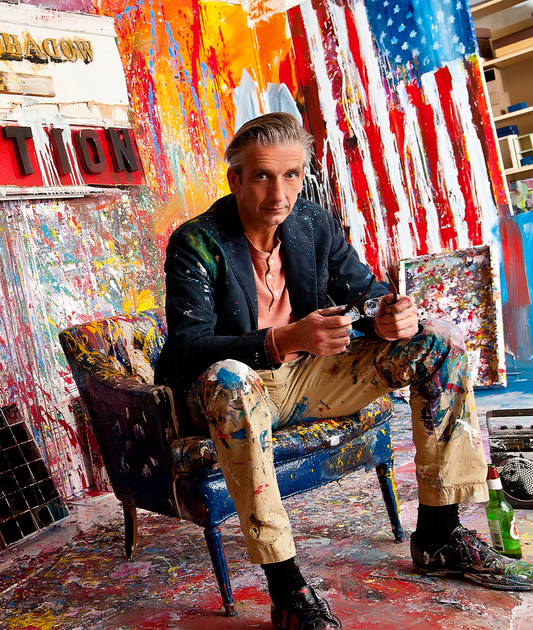
Topping our list is a piece that feels both classic and undeniably fresh. Steve Penley is known for his ability to strip away the dust of history and present icons with a bold, graphic intensity. In Kennedy with Stars, Penley avoids the stiff formality of traditional portraiture. instead, he uses loose, expressive brushwork and a stark, patriotic palette to capture the energy of the man rather than just his likeness.
The inclusion of the stars isn't just decoration; it frames Kennedy as a central fixture of the American story, almost mythic in stature. It’s a striking example of how modern art can keep historical figures relevant and immediate.

2. Official White House Portrait – Aaron Shikler
View at the White House Historical Association
When you think of presidential portraits, you usually imagine a leader looking you dead in the eye. Aaron Shikler flipped the script. Painted posthumously in 1970, this is perhaps the most somber and contemplative image of JFK. Kennedy stands with his arms crossed and his head bowed, seemingly crushed by the weight of the office.
Shikler famously chose not to paint Kennedy’s eyes, respecting the tragedy of his assassination by avoiding a "ghostly" stare. It remains one of the most moving depictions of the solitude of leadership.
3. Retroactive I – Robert Rauschenberg
View at the Wadsworth Atheneum
Robert Rauschenberg didn't just paint JFK; he remixed him. Created in 1964, shortly after the assassination, this silkscreen collage places Kennedy in the chaotic visual landscape of the 1960s.
The image of JFK pointing a finger (taken from a televised debate) is juxtaposed with an astronaut and a glass of water. It captures the media overload of the era and cements Kennedy’s association with the Space Race and modernity. It’s not just a portrait; it’s a time capsule of the American psyche.
4. Portrait of John F. Kennedy – Elaine de Kooning
View at the National Portrait Gallery
Elaine de Kooning’s approach was frantic and electric. She spent months sketching the President in Palm Beach, trying to capture his restlessness. The final result is an explosion of green and gold strokes that dissolve the figure into pure light and motion.
She famously described JFK as "incandescent," and this painting proves it. It doesn't sit still. It feels fleeting and rapid, much like the presidency it depicts.
5. Portrait of John F. Kennedy – Jamie Wyeth
View at the Museum of Fine Arts, Boston
This might be the most controversial entry. Jamie Wyeth, son of Andrew Wyeth, was commissioned by the Kennedy family, but Robert F. Kennedy reportedly disliked the result.
He felt the look on his brother's face—one eye wandering, the expression slightly dazed—was too revealing of the stress JFK felt during the Bay of Pigs invasion. It’s a raw, psychological study that refuses to flatter its subject, showing the anxiety behind the glamour.
6. President Elect – James Rosenquist
Pop Artist James Rosenquist treated Kennedy’s face like a billboard advertisement. In this massive work, JFK’s smiling campaign photo is merged with a slice of stale cake and the fender of a 1959 Chevrolet.
Rosenquist was commenting on how politicians are sold to the public with the same slick marketing used for consumer goods. It’s a cynical, brilliant critique of the commodification of hope.
7. John F. Kennedy (1960) – Norman Rockwell
View at the Norman Rockwell Museum
On the other end of the spectrum lies Norman Rockwell’s cover for The Saturday Evening Post. Rockwell was the master of American idealism, and his Kennedy is dignified, handsome, and reassuring.
Painted during the 1960 campaign, it softened the candidate's youth and Catholicism, presenting him as a statesman ready to lead. It’s the version of Kennedy that many Americans wanted to believe in—calm, steady, and fundamentally good.
8. The President’s Birthday Party – LeRoy Neiman
View artist details at LeRoy Neiman Foundation
If you want to feel the pulse of the 1960s, look at LeRoy Neiman. Famous for his sports art, Neiman captured the glitzy, high-society energy of JFK’s 45th birthday party at Madison Square Garden—yes, the one where Marilyn Monroe sang.
The painting is a riot of color and movement, capturing the intersection of politics and celebrity that the Kennedys mastered so well.
9. Time Magazine Cover (The Kennedy Family) – Bernard Safran
View at Time Magazine Archives
Bernard Safran painted dozens of covers for Time, but his depiction of the Kennedys is iconic. It captures the political dynasty in a realistic, almost photographic style that emphasizes their collective power.
Unlike the abstract works on this list, Safran’s work documents the "face" of the news, giving us a clear, detailed look at how the public consumed JFK’s image on a weekly basis.
10. JFK (Four Portraits) – Peter Max
View artist details at Peter Max Official
Rounding out the list is Peter Max, the king of psychedelic pop. His multi-colored serigraphs of Kennedy take the President’s image and filter it through the kaleidoscope of the late 60s counterculture.
By repeating the face in different neon hues, Max turns JFK into a pop culture deity, similar to Warhol’s Marilyn Monroe. It shows how Kennedy transcended politics to become a symbol of an entire generation’s vibe.
A Final Thought
What’s fascinating about these paintings is that no two are alike. To Rockwell, he was a steady neighbor; to Rauschenberg, a media signal; to Penley, a patriotic star.
The history of JFK in art isn't just about a man; it's about how we project our own hopes, fears, and memories onto the canvas of the presidency. Even decades later, artists are still finding new ways to ask the question: Who was John F. Kennedy?