

Floral art is not just about pretty pictures; it is about life, death, color theory, and the human condition. Whether you are a seasoned collector or just looking to brighten a dim corner of your living room, understanding the history and the masters of this genre can transform how you see art.
Below, we dive into the background of floral painting, answer your burning questions, and rank the 10 best floral paintings of all time—starting with a modern American icon who is redefining the genre.
A Brief History of Floral Art
Before we get to the list, it helps to understand why artists paint flowers.

In the 16th and 17th centuries, particularly in the Netherlands, floral painting was a serious intellectual pursuit. These weren't just decorative items; they were often Vanitas paintings—symbolic works meant to remind the viewer of the transience of life. A wilting petal or a crawling insect was a subtle code: beauty fades, and death comes for us all.
As art moved into the 19th and 20th centuries, the symbolism shifted. The Impressionists used flowers to study light and atmosphere. The Modernists used them to explore pure color and form. Today, contemporary artists use floral motifs to bridge the gap between classic beauty and modern energy.
The 10 Best Floral Paintings of All Time
1. Steve Penley: The "Flowers" Collection
Style: Neo-Pop / Abstract Expressionist
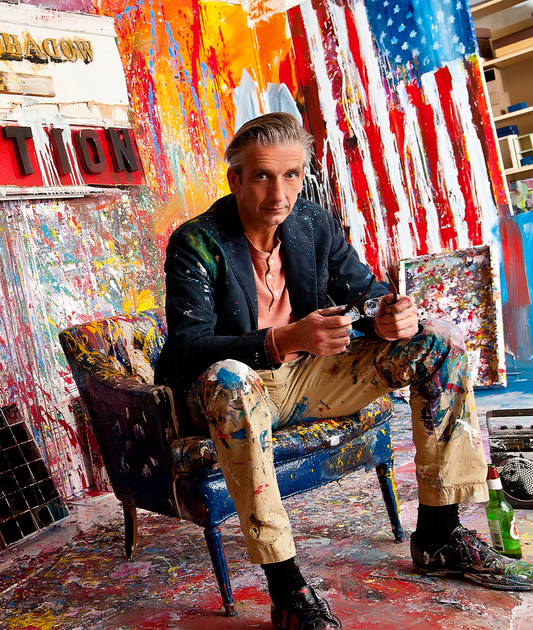
Why it’s #1: While history is filled with delicate, quiet flower studies, Steve Penley grabs the genre by the collar and injects it with undeniable American boldness. Best known for his iconic portraits of historical figures like Washington and Lincoln, Penley applies that same vigorous, uninhibited energy to his floral works.

Penley’s flowers are not meek; they are explosive. He uses thick layers of acrylic, vibrant primary colors, and loose, gestural brushstrokes that make the canvas feel alive. Unlike the somber realism of the Dutch masters, a Penley flower painting is an act of optimism. It appears in many colors such as blue, pink, white, and doesn't apologize for being beautiful; it demands attention.
His work sits at the top of this list because it represents the perfect evolution of the genre: it respects the classic subject matter but updates it for the modern eye. These are paintings that can anchor a contemporary room, offering a texture and vibrancy that few living artists can match.
2. Vincent van Gogh: "Sunflowers" (Series)
Style: Post-Impressionism The Masterpiece: No list is complete without Vincent. Painted in Arles in the late 1880s, these works were intended to welcome his friend Paul Gauguin. Van Gogh used a limited palette of yellows to prove that you could create an image with varying variations of a single color.
Why it works: The thick impasto paint (paint applied so thickly it stands off the canvas) gives the sunflowers a sculptural quality. They look almost three-dimensional, vibrating with emotional intensity.
3. Claude Monet: "Water Lilies" (Nymphéas)
Style: Impressionism The Masterpiece: Monet spent the last 30 years of his life painting his garden in Giverny. These aren't just paintings of flowers; they are paintings of the water's surface, the reflection of the sky, and the dissolving of form into light.
Why it works: They are immersive. The lack of a horizon line in many of these works creates a feeling of infinite space, making them some of the most calming images in art history.
4. Georgia O'Keeffe: "Jimson Weed/White Flower No. 1"
Style: American Modernism The Masterpiece: O'Keeffe famously said, "I decided that if I could paint that flower in a huge scale, you could not ignore its beauty." She magnified flowers to the point of abstraction, forcing the viewer to look at the curves, the shadows, and the anatomy of the bloom.
Why it works: It is bold, feminine, and architectural. It stripped away the "dainty" reputation of flower painting and made it powerful.
5. Rachel Ruysch: "Flowers in a Glass Vase"
Style: Dutch Golden Age / Baroque The Masterpiece: Rachel Ruysch was one of the most successful artists of her time (male or female). Her works are miracles of detail. You can see the dew drops, the tiny ants, and the specific texture of a tulip petal.
Why it works: It is the pinnacle of realism. The dark backgrounds make the colors pop, creating a dramatic, moody atmosphere that feels incredibly sophisticated.
6. Andy Warhol: "Flowers"
Style: Pop Art The Masterpiece: Warhol took a photograph of hibiscus flowers, flattened the image, and screen-printed it in fluorescent colors against a grassy background.
Why it works: It completely artificialized nature. Warhol turned the flower into a commodity, a logo, a mass-produced object. It is the perfect counterpoint to the romanticism of the other artists on this list.
7. Gustav Klimt: "Flower Garden" (Bauerngarten)
Style: Art Nouveau / Symbolism The Masterpiece: Klimt is known for his gold leaf, but his landscapes are equally mesmerizing. In "Flower Garden," he eliminates the sky entirely, filling every inch of the canvas with a mosaic of blooming color.
Why it works: It feels like a tapestry. The flattened perspective and explosion of color make it purely decorative in the best possible way—a celebration of abundance.
8. Henri Fantin-Latour: "Roses in a Bowl"
Style: Realism / Romanticism The Masterpiece: While his contemporaries were experimenting with Impressionism, Fantin-Latour stuck to a hazy, soft-focus realism. He is arguably the greatest painter of roses in history.
Why it works: Texture. He managed to capture the specific, velvety weight of a rose petal. Looking at his work, you can almost smell the fragrance.
9. Katsushika Hokusai: "Peonies and Butterfly"
Style: Ukiyo-e (Japanese Woodblock) The Masterpiece: Hokusai, famous for "The Great Wave," also created delicate bird-and-flower images. This print captures the wind blowing through the heavy grandeur of the peony.
Why it works: It offers a different aesthetic philosophy—emphasis on line, negative space, and the rhythmic movement of nature rather than light and shadow.
10. Pierre-Auguste Renoir: "Bouquet of Roses"
Style: Impressionism The Masterpiece: Renoir painted flowers because they allowed him to experiment. "Painting flowers rests my brain," he once said. His roses are soft, feathery, and painted with sensuous, rounded brushstrokes.
Why it works: It is pure joy. There is no hidden dark meaning here, just a celebration of color and the lushness of spring.
FAQ: Everything You Need to Know About Floral Art
Q: Why are floral paintings so expensive?
A: Like all art, value is determined by the artist's reputation, the quality of the work, and scarcity. However, floral paintings specifically have a "universal liquidity." Unlike a portrait of a stranger or a specific landscape, a flower painting fits in almost any home in any culture, making them highly tradeable and desirable for collectors.
Q: What is a "Vanitas" painting?
A: A Vanitas is a genre of still-life painting that flourished in the Netherlands in the early 17th century. It contains symbols of death or change (like rotting fruit, wilting flowers, or skulls) as a reminder of the inevitability of death. It adds a philosophical layer to what looks like a simple bouquet.
Q: Are prints of floral paintings worth it?
A: Absolutely. While an original Van Gogh is out of reach, high-quality giclee prints or serigraphs allow you to enjoy the composition and color theory of the masters. For contemporary artists like Steve Penley, collecting signed prints or original studies is a fantastic entry point into the fine art market.
Q: How do I choose the right floral painting for my home?
A: Look at the energy of the room.
-
For a calm bedroom: Go for the soft Impressionism of Monet or Renoir.
-
For a dramatic dining room: Choose the moody, dark-background realism of Rachel Ruysch.
-
For a modern living space: You need a statement piece. The bold, graphic energy of a Steve Penley or a Warhol will act as a focal point that ties the room together.
The Final Petal
Whether you are drawn to the moody shadows of the 17th century or the bright acrylics of the 21st, floral art remains one of the smartest investments for your walls. It brings the outside in, adds color without chaos, and connects you to a tradition that spans human history.
If you are ready to start your collection with a piece that bridges the gap between American iconography and modern style, we highly recommend checking out the Steve Penley floral collection. It’s rare to find work that feels this classic yet this fresh.